

Should I Buy A Drawing Tablet
Ergonomics of Graphics tablets
Published on

Nearly the 2020 remake of this commodity: For the 10-twelvemonth anniversary of this article (originally published on April 11, 2010) I decided to rewrite it. I also made new artworks and published them in higher quality. Over the years, I've been super-happy to encounter this article republished on big CG portals and printed on CG magazines; the artworks were even republished by Wacom on their web log! Recently, I had a asking for another repost, but after re-reading the commodity, I felt information technology was totally obsolete and not really in sync with what I'1000 thinking now... Since 2010 many things accept happened: the first Ipad-like tablets with styluses have come out, the historical monopoly of Wacom was breached after their patent for battery-less stylus expired, competition could finally start in the tablet market place, many new models came out (Huion/XpPen/etc...), and tablet computers with a pen are cheaper to buy and more than and more common on the desks of artists. So this update was more necessary. I hope you'll relish reading it.
Intro
The perfect graphics tablet doesn't exist. But you'll eventually adapt to the weird specifications and ergonomics issues of your tablet model and go far perfect for y'all. This adaptation of your torso to the ergonomics flaws of your hardware will have an bear on on your health in the long run. It might also bear upon the pleasure you accept in drawing and painting...
Since 2002, I have bought and used a lot of tablets in an endeavor to build the best setup I could. This was necessary for my comfort; I was doing digital painting all day. Nowaday, my quest for the all-time tablet continues, as the technology keeps evolving yr subsequently year. If you desire to read more well-nigh what I've used and why, read my maintained "Tablet history log" article, from 2002 to today. But beyond the pick of the hardware itself, I've also studied other aspects of my setup. The first aspect that comes to listen is the ergonomics of my desktop position. So, let me share my experiences on ergonomics with you.
Disclaimer: I'thousand not a professional ergonomist, I'm not working in the health-intendance industry and I wrote this article from the humble point of view of a digital painter who happens to have painted almost daily with digital graphics tablets since 2002. This article is just based on my personal experience, it contains all my biasses and should be read equally the testimony of a random creative person on the internet. I wrote it and share it because I desire to make it useful for other artists struggling with the aforementioned questions. This article doesn't have the seriousness of something like a scientific written report made on a big group with solid statistics. If you find a newspaper like that, please write it in the comments, I'll be very interested and will certainly read it.
General thoughts virtually other input devices
The keyboard
I guess I'thousand not the only CG artist who uses a lot of keyboard shortcuts to speed up my workflow. Vendors and designers of graphics tablets clearly understood that, and started to add more and more buttons on their products to give easier access to more custom shortcuts. Isn't this a sort of confession that graphic tablets are designed without thinking of a good access to the keyboard? But in the terminal couple of years, tablets vendors have started to innovate in other directions and have sometimes added tiny devices that look like remote controls (a), or just added more buttons (b), or removed all concrete buttons and proposed a virtual keyboard with touch interface (c). I'm non sure which setup will get dominant.
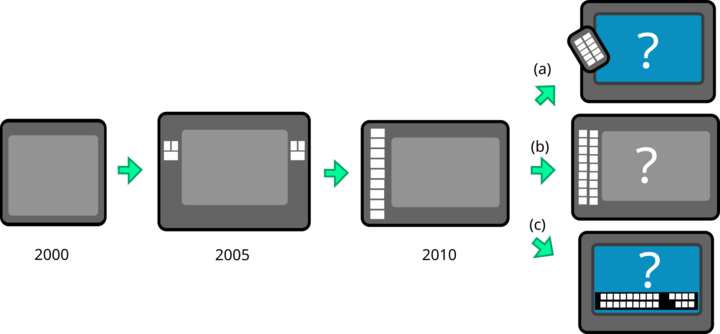 The evolution of buttons on tablets
On their side, digital artists started to use other devices in addition to tablets: gamepads, 1-handed gaming keyboards, customisable keyboards. Merely even with this research for meliorate accessibility of keyboard shortcuts, such sets of additional keys and devices volition never replace the flexibility and completeness of having a full keyboard under one hand, in my humble point of view. It is especially noticable if yous like to chat while painting, write notes, reply to emails, add descriptions in your artwork or scan for references on the web while you are working. For all these tasks, you'll need a total keyboard.
Unfortunately, a large tablet (with a brandish built-in or non) tends to land on the desk-bound in the exact place where the keyboard usually is. And then, in that location is a conflict; a competition between the ii input devices that'due south actually hard to solve. Vendors of tablets haven't put a lot of thought into this topic yet. The latter function of this commodity will consider the importance of having good access to the keyboard for this reason.
The mouse
It is tempting to think graphics tablets can fully replace computer mice. Certain they can. But for some workflows or games it is not always the instance or the about user-friendly way to utilize the software. In many situations, a mouse will exist more steady and precise and and then the workflow will be faster using it. A lot of software is developed with the features of a classical mouse in mind (e.1000. the mouse bicycle and mouse bike click to zoom/pan). That's why I think it is necessary to keep an extra mouse on the desk.
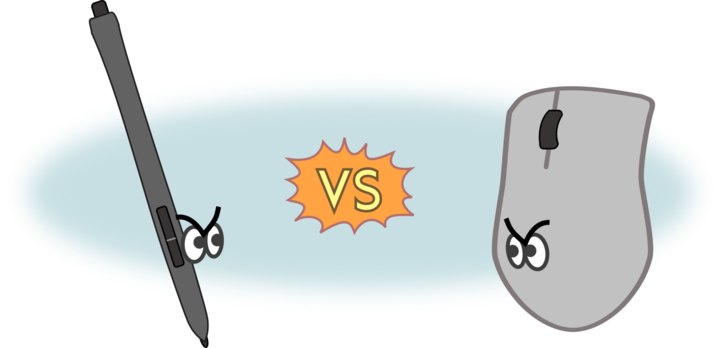 Stylus versus Mouse? And why non both.
Note about old tablets: Before 2010 many tablets −such every bit the Wacom Graphire 3− had a mouse delivered in the package. This mouse just reacted to the active surface of the tablet. This trend was abased and I tin can understand why: the mouse had to be removed from the active surface area each time the user switched between the pen and the mouse. I had two models like that; the built-in mouse was neglected in favor of a classic mouse continued to the system. I never used information technology.
i. Big graphics tablets
Large classic graphics tablets (without a built-in monitor) are certainly the most precise and comfortable from a technical signal of view. But the number of big classic models bachelor is decreasing and they are gradually disappearing from the market. Information technology'southward a shame because in the final five years, monitors went bigger and higher-resolution for a cheaper price. The aforementioned tendency should have been followed in tablets, with the emergence of new large graphics tablets with high resolutions. Just that's non been the case.
Around 2000, a "1024x768px 15inch CRT" display paired with a medium tablet was a good friction match. Nowaday, information technology would be hard to use the same size of tablet on 1 of our modern wide "FullHD 1920x1080px 21inch brandish" (and I'thousand not even talking about the 24inch, 27inch, quadHD, or 4K resolution which are get in cheaper and more and more than common). In this context, for modern users of PC on desktop with a large external monitor, adopting a large tablet makes sense for improve command of the pointer on the monitor. Indeed, if you draw a money-sized circle on your small tablet and it displays as a huge balloon on your monitor, you lot'll feel you lot have no control over painting details. You can imagine how you lot'll struggle to draw a picayune centre or a detail. It will always exist possible only you'll have to zoom a lot to residue your hardware's precision problems.
But large tablets have also a lot of cons. The first one is their price and the second one is the room they volition have on your desk.
a) Large tablet, on the side
The first place people usually put their new large graphics tablet is beside their keyboard, like a mouse pad. This position stresses and hurts the arm and shoulder. Simply this position might be good plenty if your main job is typing text and yous'll demand the tablet only once or twice a day. I saw this position being used by the people convinced the graphics tablet should replace the mouse. Vendors of graphics tablets have run commercial campaigns promoting the tablet as a healthier replacement for the mouse. For someone with repetative stress injury from mouse overuse, a tablet can be indeed a good choice. While visiting studios of 3D artists and video editors, I often saw this type of layout on desks. At the end of the day, I don't advise it unless you demand a large tablet and have issues with mice.
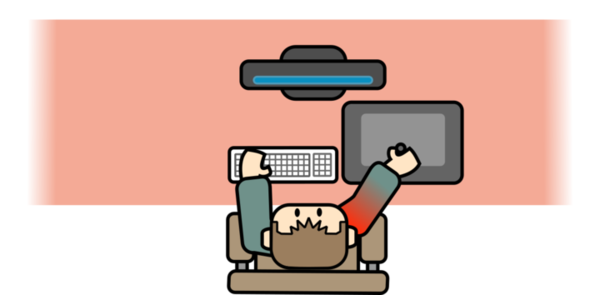
b) Big tablet, centered
One solution is to put the graphics tablet in the center of the desk and your keyboard off to the left. Having the agile surface of your tablet aligned to your brandish in this way allows comfy motion and increases your power to paint for hours. But if you demand to accomplish the keyboard too ofttimes, this layout can quickly become a hurting. Information technology will force you to twist your dorsum to face the keyboard, fifty-fifty if it's only a slight angle, and you'll take to counterrotate your neck to look at your monitor. Also many useful keyboard shortcuts (eg. Ctrl+Z, Ctrl, Ctrl+S, Shift) are located on the left part of the keyboard. I wouldn't advice a position like that either.
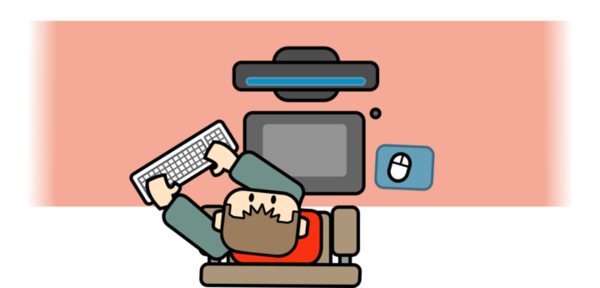
c) A tray for the keyboard (or keyboard on lap)
To keep the keyboard easy to reach, a reasonable solution is to prefer one of these trays you can screw under any type of desk-bound (except if your desk is made of glass) to get a keyboard that can be mounted under the desk-bound. The cheap alternative is to put the keyboard on your lap. I have this setup but I'm not a fan; this position makes it difficult to write on the keyboard.
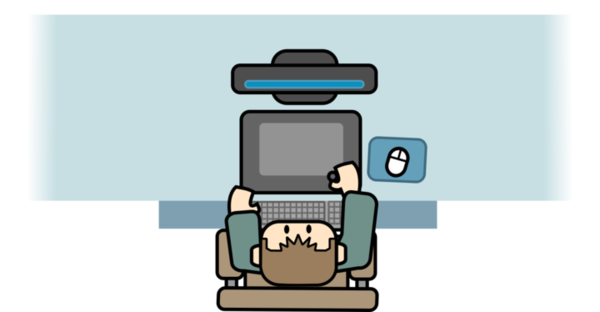
d) Curved desk-bound
Adopting a curved desk with a swivel chair improves the state of affairs a lot compared to (b). By mapping devices closely all around you, you tin can avoid twisting your back or extending your arm too much. You'll also benefit from having a part of the desk to remainder your arm on. I had this setup for a calendar month while I was working at a studio and it was working actually well. 1 of the problems with a curved desk-bound is that they are ofttimes big, deep, and corner desks, which need to exist placed in a corner of your room. I tin't get ane for use at home for this reason.
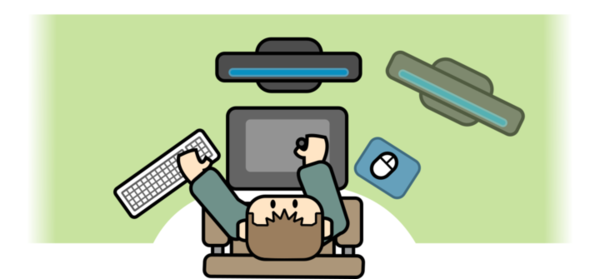
due east) The keyboard on top of the tablet
My favorite layout, the one I've been using for years, requires a piffling bit of DIY. First, the monitor needs to float on ane of those horizontal metal arms. That way y'all'll have room to put more things nether the monitor (y'all won't be blocked by the monitor'south stand). For the typing/keyboard position: identify your keyboard on the far side of your tablet. To protect the fragile surface of your tablet from scratches, you'll need to glue little sticky pads nether your keyboard (normally made for putting under piece of furniture, sold in DIY stores). The keyboard will glide more hands this mode, too, switching betwixt positions with but one movement. Then the last piece of the installation is a thick volume or a plank of forest on the far side of your big graphics tablet, correct under the brandish (non shown in the effigy beneath, I forgot it). Information technology will be an area for y'all to push the keyboard or to grab it when you lot demand to type something. The keyboard will remain also attainable for using shortcuts while painting.
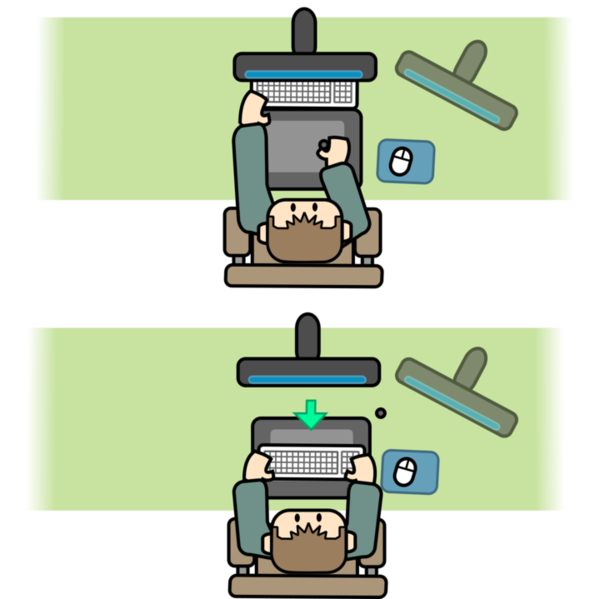
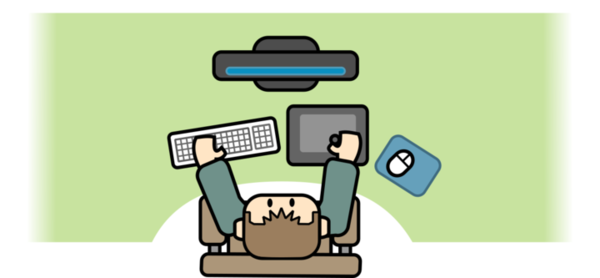
2. Small/Medium graphics tablets
These graphics tablets by and large have a smaller price and a smaller agile surface area (and still no built-in monitor). They are of grade less precise than the larger tablets. Tablet vendors try a wide diversity of attractive designs, and optimizations to create inexpensive products. That'south why so many small/medium tablets exist on the market. with a wide spectrum of quality and pattern. At that place are non more of them because they are better, just only because they are much cheaper. They are often coonsidered entry-level tables, for all sorts of consumers (and many digital artists started this way, me included). With a desktop reckoner, the ergonomics of small graphics tablets are usually better than those of larger tablets.
f) Angled-axis
Here is how I adopt to use this size of graphics tablet: I rotate my whole body, putting my body'due south axis at an angle to the edge of the desk-bound. This gives me a large spot to rest my elbow. I tin paint for longer periods this style. You can annotation that while it was problematic to keep a big tablet (a)(b) on the side of the keyboard, it isn't a trouble for a smaller tablet.
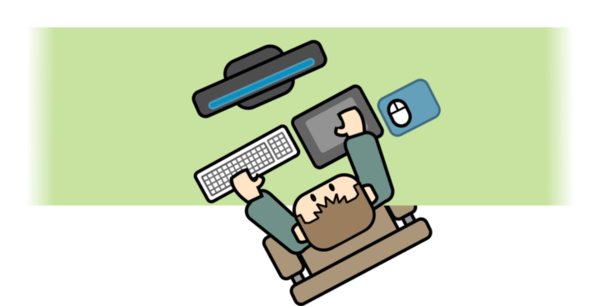
g) Curved desk
Here once more, as in (d), adopting a curved desk will better the ergonomics of your workspace a lot.
3. Laptops, mobility and travel
The users of graphics tablets often need to travel to another identify to work. This means they frequently require a mobile style to work. A laptop can be used on the transit, at the desk of a client, in front of a classroom or during a conference... Graphic-tablet vendors don't have much past way to creative solutions for this use-case. Simply ane innovation on the market has actually inverse everything: tablets with built-in computer and display.
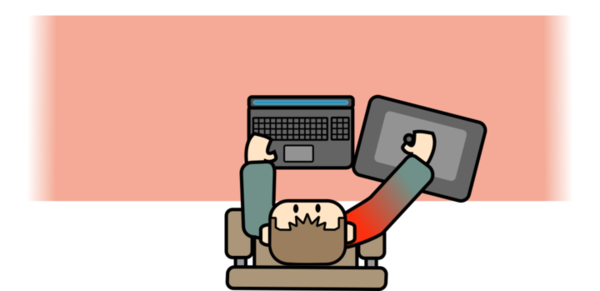
h) The incommunicable match
Using a laptop and large tablet is hell and often doesn't work at all. I know it sounds obvious, simply it's something to consider while ownership a large tablet: it isn't really mobile-friendly.
i) The small tablet: flexibility
Working with a laptop and a small tablet is not that bad and can work in a lot of situations. Small tablets are usually also made in A4/Alphabetic character size, aforementioned equally standard Eu/US paper. This is great because it makes them compatible with many numberless, so there are more packing options for travelling with them.
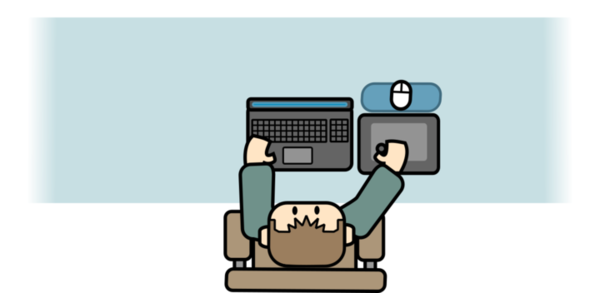
You can prevent hurting in this setup by putting it at a slight bending with the desk-bound. I taught in the classroom with a setup like this (when the desk had plenty room) and I did a lot of public demos this way, likewise.
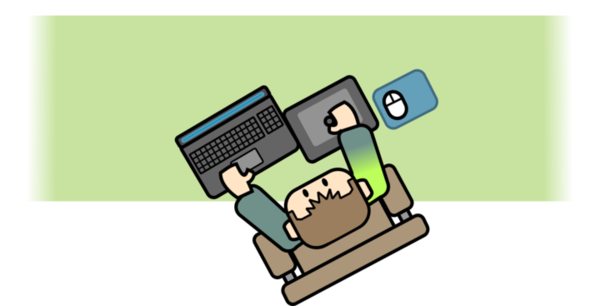
Another layout I bask using. I can encompass the bear on-pad of the laptop with the tablet, and marshal it with the monitor.
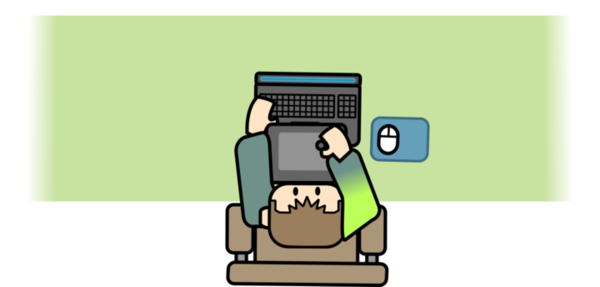
j) During travel
Little graphics tablets tin can be useful on a plane or a train. They are flexible enough to exist used on this type of temporary and uncomfortable state of affairs. Merely believe me, utilizing a long 5h train trip by completing a full artwork on the mode feels very rewarding.
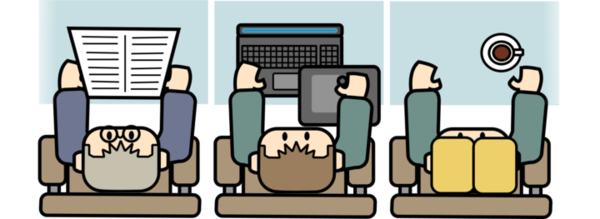
The setup to a higher place (with laptop and graphics tablet stacked) will hopefully shortly exist something from the past. Many impact tablets with styluses have appeared on the market, and they offer much meliorate ergonomics.
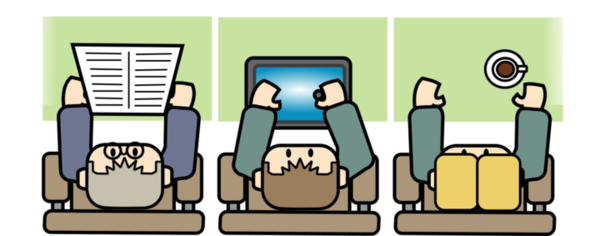
I'thou rarely excited by these devices considering I dislike all mobile operating systems in general and I dislike typing on touch devices. Just possibly my feelings will change as the engineering develops. I'm antisocial using my phone less and less, so perchance the user experience on touch tablets will likewise improve. Meanwhile, if yous take the room for it, I still would suggest using touch tablets with an external keyboard.
4. Large graphics tablets with integral displays
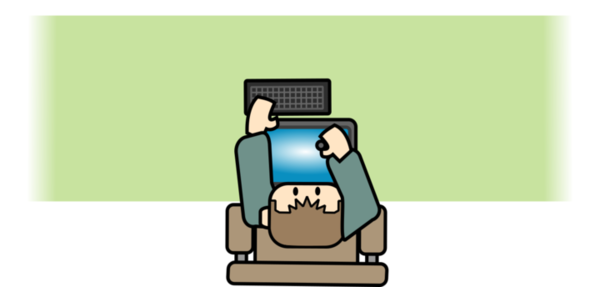
The large models of pen tablets with integral displays all have the same big ergonomics bug. I've owned or tested a lot of tablets with a display over the years. While the technology hasn't changed a lot for the classic graphics tablets, the specifications of the graphics tablets with a display have inverse a lot over the years (cheers to the monitor, phone and tablet industries; I recall the first Ipad was released in 2010...). These graphics tablets allow working straight on the surface and the sync between the easily and the optics is better. They make gesture drawing easier and requite more than precision for line art and drawing.
When large tablets with an integral display first appeared on the market, they were very expensive devices. Nowadays they simply cost a tertiary of what what they cost effectually 2005. The problems of these devices: there may be noticable parallax (apparent distance between the tip of your stylus and the image on the screen), your paw might get warm on some areas of the devices, leading to pasty hands and your having to clothing a glove (a side effect of having an electric monitor nether the palm), the surface of the tablet is rarely able to offer a good texture (vendors and designers often have to choose between getting a slightly blurry epitome with textured feeling for the stylus, or a crystal-clear paradigm with besides-smooth glass), the surface is fragile (dirt trapped betwixt the stylus and the surface can scratch it) and it'southward harder and more expensive to replace the overlay-sheet on a brandish tablet than on a archetype tablet.
one thousand) A tilted surface: a three-dimensional effect
The surface of the tablet will always be tilted like an easel: it'south rare to become a large model flat plenty to employ as you would employ a large sheet of paper, flat on the desk. And then you have to use the built-in stand up provided with the tablet, which is ofttimes designed mainly to be used in but two positions: an easel-like position with more or less slope (simply with the lower edge always as well high above your desk, compared to the thickness of a sketchbook) and a vertical-like position to use the tablet as a monitor. This bending makes it harder to admission to a keyboard on the side, and then it is useless to place a keyboard in that location.
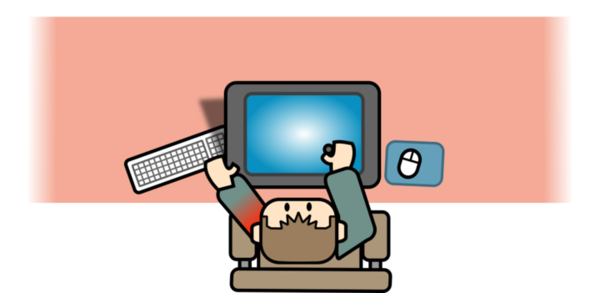
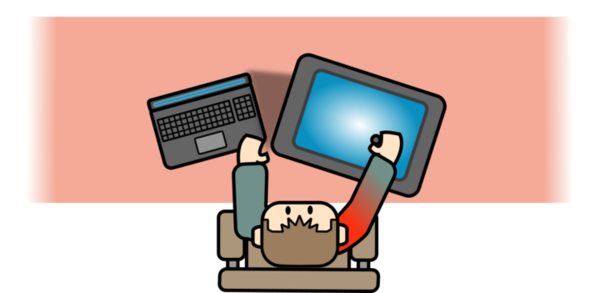
l) Keyboard on top
Because the surface is tilted, you besides can't put the keyboard over the surface. You lot'll take to purchase a defended rig for that (in orangish on the figure below). Tertiary-party vendors advise this, simply it's never proposed past the vendors of tablets themselves. I think a built-in solution, designed as part of a big display tablet, would be great.
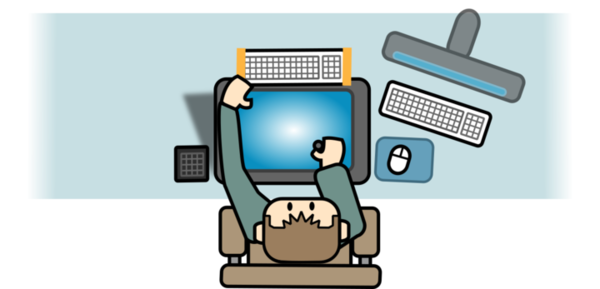
m) Keyboard underneath
Placing the keyboard on your lap −often pregnant under the desk− is one bad possibility as it will put more altitude between you lot and the surface. Putting the keyboard between you nad the tablet is some other variation that might work.
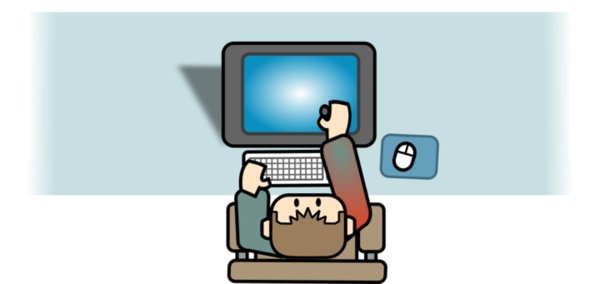
n) Dual positions
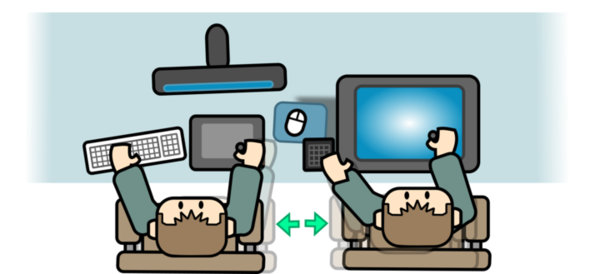
With a wheeled chair, information technology is possible to take two setups side-by-side, connected to the aforementioned computer. On one side, a large pen brandish; on the other, a monitor with a keyboard and a small graphics tablet. This way, you tin use the large pen brandish just for the long hours of painting.
o) The big DIY
I of the best ways to use a big pen tablet is to cut a hole in the desk (a drawing table) and merge the surface of it flush with the tabular array/desk. This is a rare setup, just one I saw amidst many professional manga artists. This video (in Japanese) by artist Yoshikadu shows step-by-step insturctions for making a circuitous rig like that. Impressive!
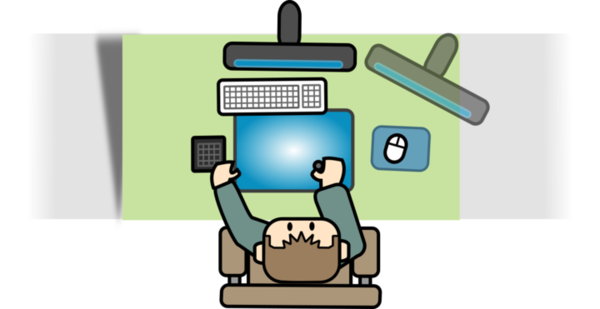
Annotation most bear on devices: I've never tried the very large pen tablet displays with 'touch' on-screen virtual keyboards. My feeling nigh them are mixed; while I can see that having a keyboard in the corner of your screen could solve many ergonomics issues, I'grand all the same not fond of typing or gaming on touch keyboards, and I notice virtual keyboards are still junior to physical buttons...
5. Small graphics tablets with display
Pocket-size graphics tablets with a brandish are normally cheaper than the larger models but also flatter. This detail changes a lot of things because y'all can use them as y'all would apply a sketchbook or a sheet of paper on your desk. They can oftentimes also be used every bit with an external monitor, mimicking a classic graphics tablet. This hybrid setup often offers the best of both worlds, when managed correctly.
p) The hybrid setup
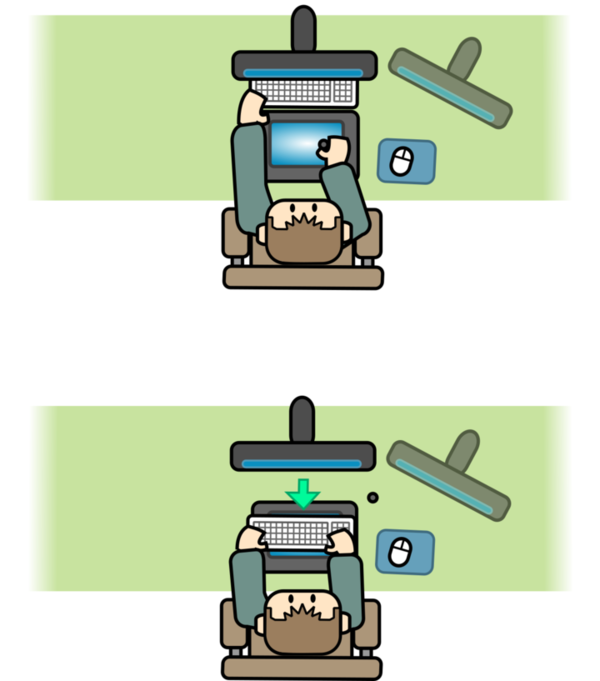
A minor graphics tablets with a display is oft as large equally a "large archetype tablet" (without brandish). A xiii inch or 15-sixteen inch might be as large as a "big" archetype model. By using them with the picture on the monitor cloned to the primary tablet display, information technology's possible to get a hybrid workflow. You tin can get the tablet and keyboard ergonomics of a archetype large tablet, and also get the bonus possibility of looking at the tablet for more than precise drawings.
Decision
Equally I said in the intro, the perfect graphics tablet doesn't exist, and the best mode for you to find one that suits your body and lifestyle may well be to endeavor a lot of them. But I also desire to insist that nosotros all accept bodies and habits that can arrange: a not-so-comfortable tablet, too smooth and too big, might still become your best hardware and all-time tool if you take the effort to commit to painting hours and hours on it. I, likewise, work this way.
And so, if you already own a tablet, accept care of it, whatever model it is; it tin produce your next masterpiece. Just understand information technology, and with only what you observe around yourself, and a bit of DIY, you tin can build and optimize a better environment, and bask your painting time longer. I hope this article inspired you to take a bit more than care over your work position and think most information technology more than. If you want to share your experience and continue the word, y'all're welcome in the comments section at the bottom of the page.
Foot notes:
- All artwork (Inkscape source for the nugget) examples were drawn with a male effigy, right-handed. It wasn't designed to exclude all other genders and left-handed artists, I'k sure you'll get it and sympathize how to adapt this example to your state of affairs.
- As I'k French, my English is far from proficient enough to write an article like this. If you find some mistakes and want to contribute improvements, feel free to grab the source file of this article (link under, markdown file), right it, and ship me back by email with your corrections.
Changelog:
- 2022-03-07: English correction pass, thanks Hjenkins!
- 2020-09-xvi: Proofreading laissez passer, thanks Yorwba and Chris K.!
- 2020-09-13: For the ten years, refactor of the article (artworks and text).
- 2010-08-04: Proofreading pass, thank you Slug45!
- 2010-04-xi: Original release date of the article.

Source: https://www.davidrevoy.com/article30/ergonomics-of-graphics-tablets
Posted by: ricetheessale.blogspot.com
0 Response to "Should I Buy A Drawing Tablet"
Post a Comment